Vocabulary practice
Turn reading vocabulary into flashcards with context
A worked example of choosing words from a passage, keeping their original sentences, and reviewing meaning with Kalima’s contextual flashcards.
Screenshots illustrate the app; book text and the pronunciation example retain their original language.
Keep the sentence with the word
To turn reading into vocabulary practice, save a useful word together with the sentence where you found it. Later, try to recall its meaning before checking the answer, then return to the sentence. Kalima connects these steps by saving vocabulary with its sentence and source and providing flashcard reviews at intervals that adapt to what you remember. How to learn a language by reading books
Context gives you a specific question to answer. If you save only “light,” are you practicing something you can switch on, something that is not heavy, or a pale color? A sentence identifies the meaning that mattered in your reading. You can learn other uses later without forcing them all into the same first review.
Work through one small example
Original practice passage
Before leaving, Nina checked the weather. She packed a light jacket and left a note for her brother. The bus was late, so she waited under a tree.
Imagine that you understand the scene, but “packed,” “light,” and “note” are unfamiliar. You could look up each one to follow the passage. Saving a word is a separate decision: choose the one you want to recognize next time. In this example, start with “light” because its meaning changes with the noun around it.
- Word: light.
- Original sentence: “She packed a light jacket and left a note for her brother.”
- Meaning here: a jacket that is not heavy or thick.
- Question for yourself: what kind of jacket did Nina take?
This is a worked learning example, not a claim about an automatically generated answer in the app. If your lookup suggests a meaning that does not fit the sentence, examine the context again. You want the meaning of “light jacket,” not the first definition you happen to see.
Save a manageable selection
A reading session can produce more unfamiliar words than you want to review. Before saving one, ask whether it matters to the passage, has appeared more than once, or belongs to a topic you want to talk about. These are practical selection prompts, not rules about how many cards a learner should create.
For the Nina passage, you might keep “light” and leave “packed” for another session. You can still look up “packed” without committing to review it. If yesterday’s review already feels too long, read today without adding more cards. Keeping the routine usable is more valuable than turning every page into a growing collection of unfinished work.
Kalima saves vocabulary with its sentence and source. Use that link to the reading whenever a word feels detached from its meaning. The app also supports definitions and translations while you read, so checking a word and deciding whether to keep it can happen in the same reading workflow.
Recall first, then check the answer
When you review, pause and try to remember the meaning before revealing or studying the answer. For “light,” picture Nina choosing her jacket. After checking, compare your answer with the meaning in that sentence. Recognizing an answer once it is visible is different from having recalled it yourself; rate the review according to what actually happened.
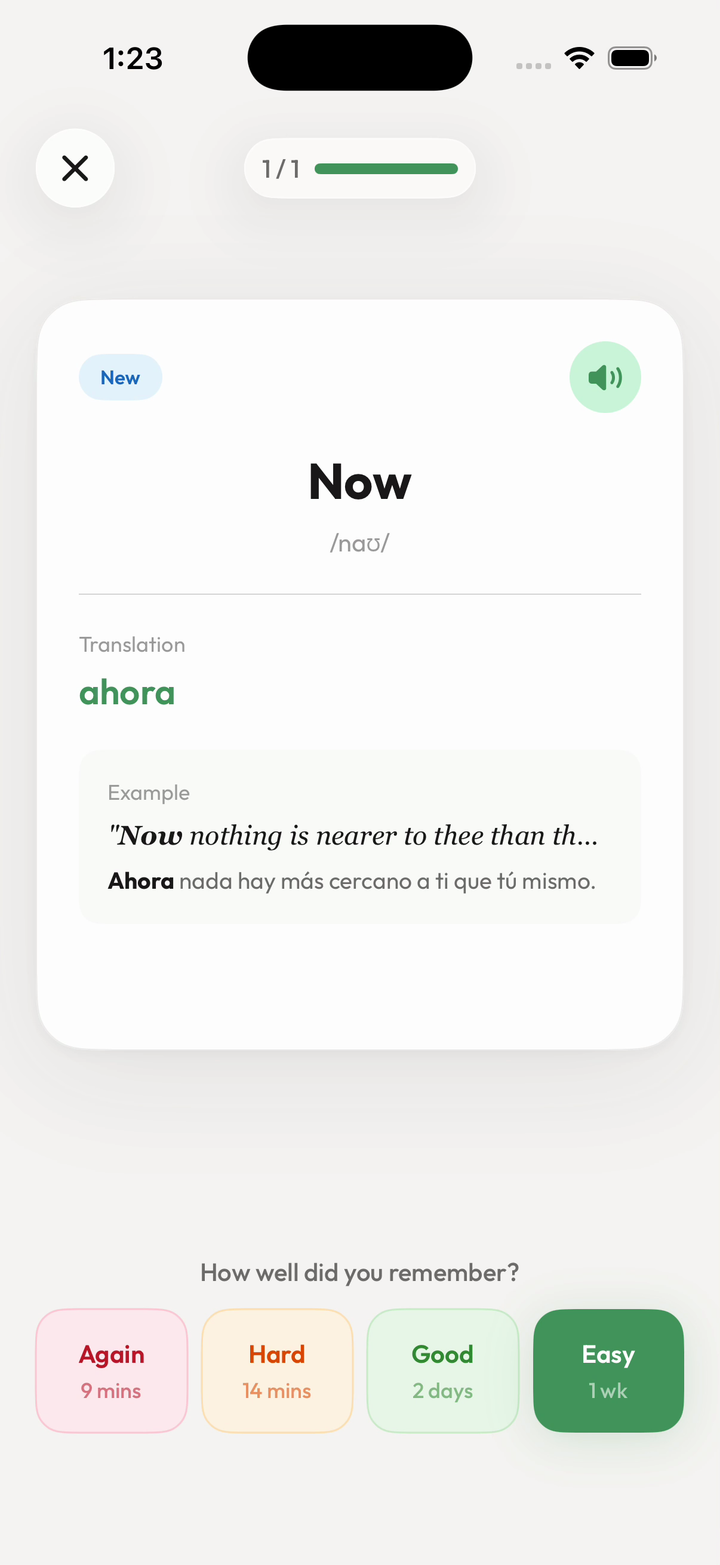
Kalima offers recall ratings and adapts review intervals to what you remember. Choose the rating that reflects your recall instead of selecting an easier rating just to move the word out of the queue. The intervals shown in a screenshot are examples of that review state, not a fixed timetable for every card or learner.
Take the word back to the page
After reviewing, read the original sentence again. Then try a new sentence: “I need a light bag for the trip.” Does the same meaning fit? Now compare “Turn on the light.” It uses the same spelling differently. This small comparison can help you notice what you do and do not yet understand without turning one card into a list of every possible definition.
Finish by continuing your book. When a saved word appears again, check whether you understand it in that new sentence. A correct flashcard answer is useful practice, but it does not by itself show that you understand every use of a word. Let your next reading give you another context.
Kalima requires an account. Core reading and vocabulary workflows are local-first, while language assistance and other network features need a connection. You can begin with a short imported text, save a small selection, review what is due, and spend the rest of the session reading.